
Blog
Embroidery Digitizing Explained in Simple Terms

Most people never think about what happens between sending a logo and seeing it stitched onto fabric. There’s an entire process in between that involves translating your artwork into thousands of individual needle instructions before a single thread is placed. That process is called embroidery digitizing. This guide simplifies the technical side of digitizing with straightforward explanations. We explain the process of what takes place behind the scenes to turn your artwork into embroidery digitized files.
The Evolution of Embroidery Digitizing: From Hand Punch Cards to Digital Files
Embroidery itself is centuries old, but machine embroidery digitizing is less than 40 years old. Before the mid-1980s, machines ran on punch cards and could only sew fixed, predetermined patterns. Digitizing software began appearing in the late 1970s but was expensive and complex, limited to large commercial operations.
Throughout the 1990s, more computers became common in households and digitizing machines became available for smaller commercial entities. The digitizing programs of the early 1990s were very difficult to learn and created unstable results. But with the advances of easy-to-use digitizing software, faster embroidery machines and the internet during the early 2000s, custom embroidery became available to everyone worldwide. What started as a tool for printing sportswear logos for corporate uniforms soon became an asset in African fashion that will change its course.
West Africa’s Digitizing Pioneer: FAMK Apparel’s Untrodden Path
While the Western market was busy using digitized embroidery for corporate logos and branded sportswear, no one had turned that technology toward African garments. Digitized embroidery existed in Nigeria in the early 2010s, but only for caps, name stitching, and print-on-demand for company logos. African Garments were untouched. We at FAMK Apparel were the ones who asked the question nobody else was asking: “what if we digitized not for company uniforms, but for agbadas, kaftans, boubous and danshikis?”

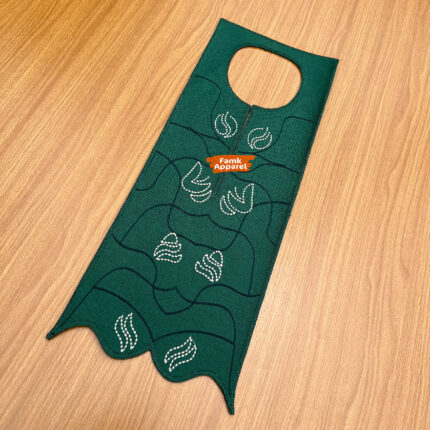
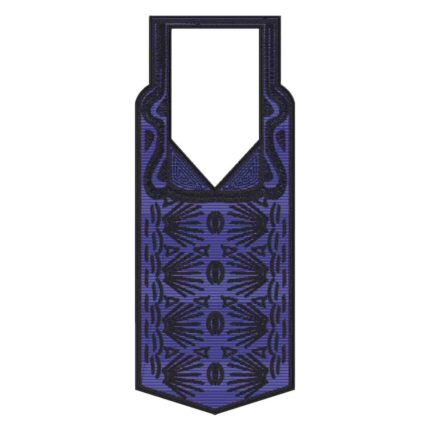

Digital embroidery wasn’t the norm or commonplace in African fashion when we started out. We were adventurous, crazy and took the leap into the unknown while everyone else thought we were silly. It was a thankless job at first; things took time, were hard to catch on to and many didn’t believe in our vision. Tailors believed the art could not be replicated on a machine as the traditional looks. Clients believed that digitalizing would not be as precise as hand embroidery. We persevered because we had a vision: to revamp how Africans access quality embroidery for their fashion.
Why FAMK Became West Africa’s Best Embroidery Digitizing Service
You wouldn’t be incorrect to say that FAMK Apparel pioneered digital embroidery production by offering machine embroidery digitizing service for ready-to-wear African fashion garments. We were the first to digitize embroidery patterns using methods tailored to how damask shrinks with high stitch counts. We learned how brocade requires unique underlay techniques compared to Western twill fabrics.
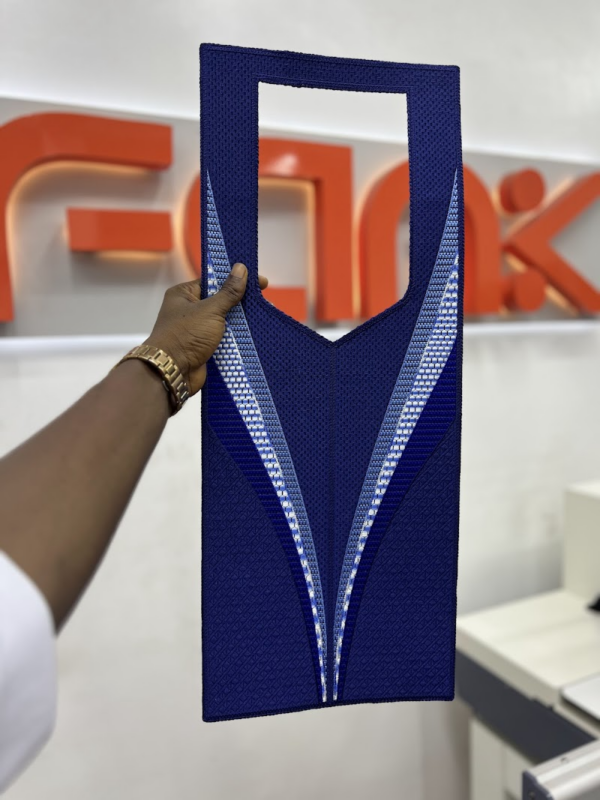
We experimented with scaling intricate designs to fit large expanse of fabric on flowing boubou sleeves and tailored agbada torso details. This wasn’t as easy as just downloading embroidery digitizing software. Western embroidery digitizing methods were incompatible with African textiles and styles. We spent years prototyping different stitch types and densities, thread tensions, and methods of stabilizing thick guinea cloth, light aso-oke material, and everything in between. It’s these details that set us apart and have led customers to regard us as providers of the best embroidery digitizing service for African garments.
What Is Embroidery Digitizing in the Simplest Terms?
Embroidery digitizing is the process of converting artwork into machine-readable embroidery stitch files. It’s similar to the translation process of a book from one language to another. The story being told remains the same, but completely different words are used.
In practice, a digitizer looks at your artwork and makes thousands of small decisions. That curved line? Two hundred satin stitches, angled at 45 degrees. That solid filled shape? Over a thousand fill stitches spaced 4mm apart. Those fine details at the edge? Running stitches, because anything heavier will pucker the fabric. By the time the file is complete, it contains an instruction for every single needle movement, and the machine follows them exactly. Creating your design one stitch at a time.
How Does the Digitizing Process Actually Work?
Digitizers will open your artwork into digitizing software such as Wilcom, Pulse or Hatch and begin tracing elements that they want to stitch out. Elements may require fill stitches, satin stitches (usually used for borders and text) and running stitches (detail and outlining). Stitch direction (the angle of each stitch laid down) can also be controlled by the digitizer. Stitch direction changes are used to add visual texture, as the thread’s sheen reflects light differently depending on the stitch direction. Digitizers place underlay stitches under the top show stitches.
Underlay stitches are typically used to prevent the fabric from showing through the top stitches and to stabilize it against the pull of the stitching thread. Digitizers then create a stitch file that contains every movement of every needle. An embroidery digitizing company will usually stitch out their stitch files to check for errors that may not show up on a computer, such as puckering, gaps, and registration.
What Makes Quality Digitizing Different From Poor Digitizing?
Good digitizing will embroider smoothly without thread breaks, lay flat without puckering, produce crisp details at the correct viewing size, and build embroideries that will hold up over time and through washings. Bad digitizing will produce files that look wonderful in your editing software, only to have everything fall apart when you stitch it out.
Too many stitches per inch will make the embroidery stiff and overly thick. Not enough underlay can cause the fabric to show through. Both horizontal and vertical stitching can make your embroidery look lifeless. Lastly, jump stitches should be minimized as they will need to be trimmed by hand. Quality digitizing companies know these things and will compensate for different types of fabrics. They will run tests and make adjustments based on the results. The goal is to produce files that stitch out properly the first time. The goal is files that stitch out cleanly the first time: no puckering, no thread breaks, no stiff patches where the stitch count got too heavy. For standard Western fabrics, experienced digitizers can get close to this on the first attempt. For African textiles, it took us years of physical testing before we could say the same with confidence. That experience is what quality digitizing actually looks like in practice.
Final Thoughts
At FAMK Apparel, we started doing machine embroidery for African garments when most people, including tailors and clients, told us it couldn’t be done properly. The tailors said machines couldn’t replicate the traditional look. The clients said it wouldn’t be as precise as hand embroidery. We believed otherwise, and we spent years proving it on actual fabric before we were certain enough to say it out loud.
Today, the same process that felt uncertain and experimental is the foundation of every design we produce. We have pleased thousands of customers by providing them with high-quality monogram embroidery designs at reasonable prices. Being that we are West Africa’s very first machine embroidery digitizing company, specializing in traditional wear. Technically sound, tested on African textiles, and built to last. If you’re looking for embroidery digitizing done right for African fashion, you’re in the right place. Browse our ready-made agbada designs, kaftans and flap collections or reach out if you have something custom in mind.