

Blog
Male Embroidery Designs: Hand-Stitched vs. Machine – Which Suits Your Budget & Style?

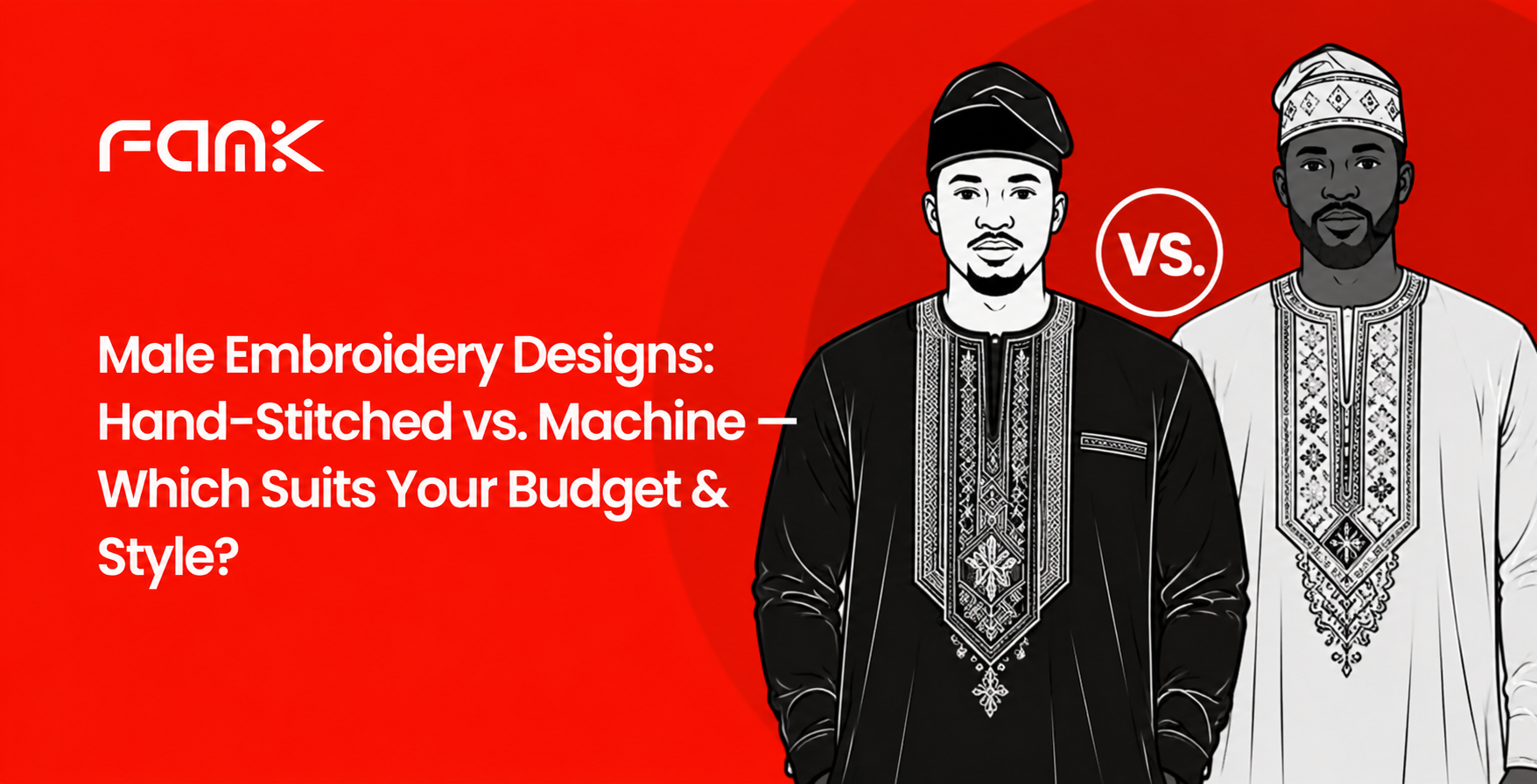
Most men do not walk into this decision with strong opinions about stitching technique. They walk in with a garment, an occasion, and a rough sense of what they want it to look like. The hand versus machine question usually surfaces later when a tailor mentions it or when the price difference between two providers raises an obvious question about what exactly is different.
It is a more interesting question than it first appears. And the answer is genuinely not the same for everyone.
What Hand-Stitched Male Embroidery Designs Actually Involve
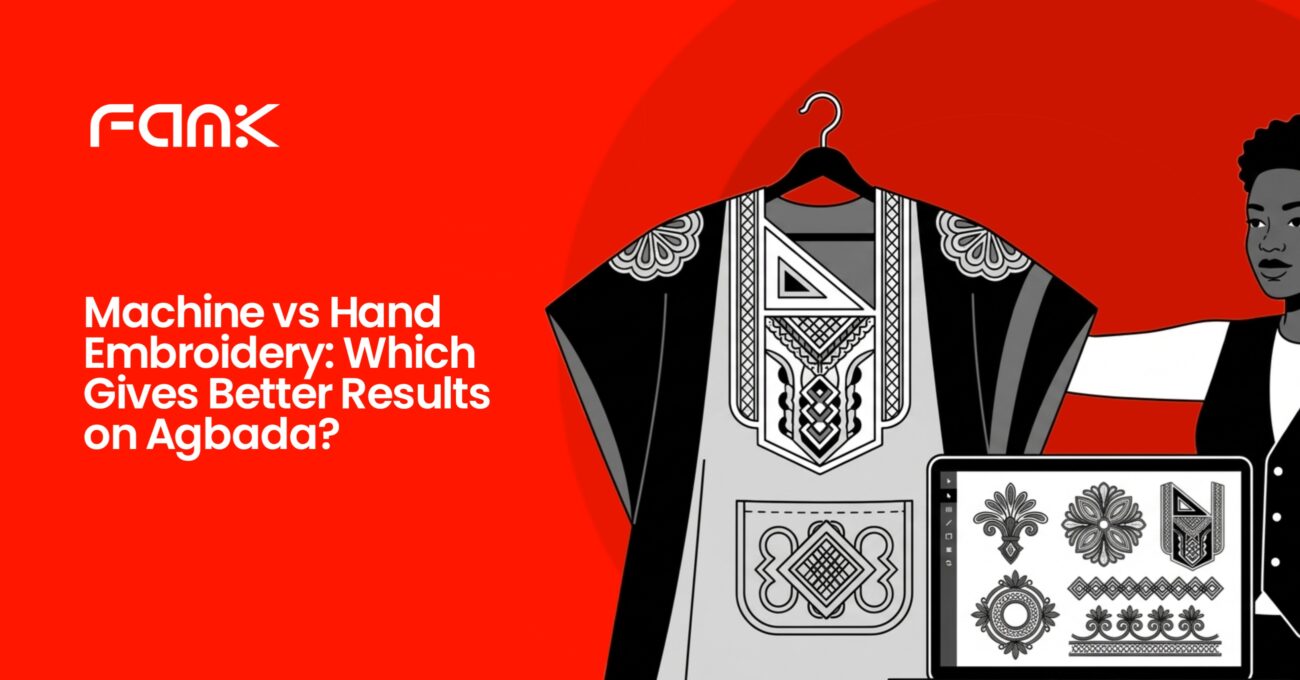
Hand embroidery on a Nigerian agbada or kaftan is exactly what it sounds like; a skilled artisan, a needle, thread, and time. Significant amounts of time. A detailed male embroidery design on an agbada chest panel can take anywhere from one to four days depending on the complexity of the motif and the density of the coverage.
What that time produces, at its best, is a kind of variation that machines cannot fully replicate. Each pass of the needle is slightly different from the last. The imperfection is not a flaw — it is evidence of human craft. In heritage and luxury contexts, that evidence has real monetary and cultural value. A master artisan’s work on a ceremonial agbada communicates something a stitch file simply cannot.
The problem, honestly, is that master-level hand embroidery artisans are harder to find in Nigeria in 2026 than they were twenty years ago. The craft pool is shrinking. What often gets sold as hand embroidery in the mid-market sits well below that standard; it’s usually inconsistent stitch tension, variable density, and execution that looks rushed because it was. At that level, the premium you pay for hand stitching is not buying you quality. It is buying you a method.
What Machine Embroidery Designs Deliver
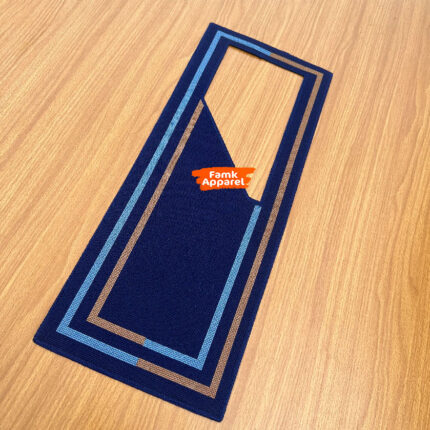
Machine embroidery designs run from a digitised stitch file — a set of instructions that tells the machine precisely what to do. Stitch type, path, density, colour sequence, underlay. Every variable pre-determined before the needle touches fabric.
The output is consistent. The same agbada embroidery design stitched on the first piece in a 50-unit Aso-Ebi order looks identical to the last. The monogram that passed the PDF proof is the monogram that arrives on the garment. There is no interpretation, no variation, no artisan having an off day.
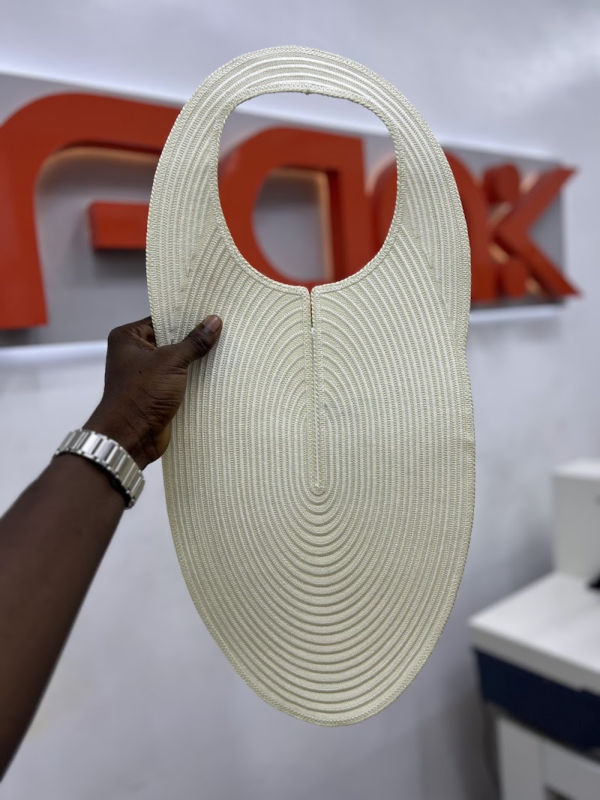
For embroidery designs for men at production scale—Aso-Ebi orders, branded apparel, and uniform collections—this consistency is not a nice-to-have. It is the only workable approach. Hand stitching 200 identical pieces is not commercially viable for any tailor or fashion brand operating in the real world.
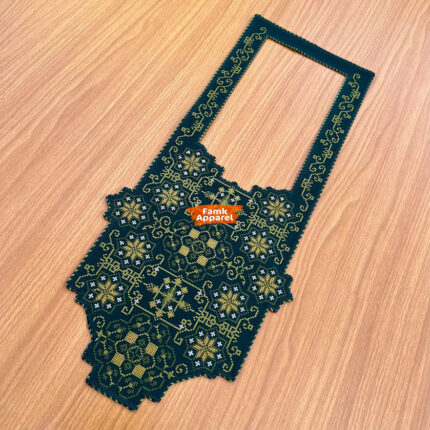
Where machine embroidery falls short is in the craft story. A digitised stitch file does not carry the history of a human hand. For buyers in the bespoke or heritage segment, for example, men commissioning a single ceremonial agbada, where the making process is part of the object’s meaning, that absence matters.

The Budget Comparison
This is where things get less straightforward than most comparison articles admit.
Hand embroidery at a genuine master level is expensive. Rightly so. The time investment alone justifies a significant premium, and in the luxury segment, that premium is part of the product’s identity. A high-end hand-embroidered agbada is not competing with machine production on price. It is not trying to.
Mid-market hand embroidery, which is most of what is actually available, costs more than machine embroidery and frequently delivers less. That is the uncomfortable truth. You are paying a premium for a method without necessarily paying for the skill level that makes the method worth it.
Machine embroidery with poor digitising quality is cheap and looks it. Thread gaps, puckered fabric, monograms that lose definition at actual stitch size. The low price reflects the low standard.
Machine embroidery with strong digitising, fabric-assessed proofing before production, and execution by someone who understands African garment proportions sits at a price point that most buyers find reasonable and delivers results that outperform mid-market hand stitching consistently.
| Method | Quality Ceiling | Cost | Best For |
| Master hand embroidery | Irreplaceable | High | Bespoke ceremonial, luxury heritage pieces |
| Mid-market hand embroidery | Variable, often inconsistent | Medium-high | Hard to recommend without vetting the artisan |
| Machine embroidery (poor digitising) | Low | Low | Not recommended for any occasion wear |
| Machine embroidery (strong digitising) | High, consistent | Medium | Production orders, occasion wear, Aso-Ebi, branded apparel |
Which One Actually Fits Your Style?
Style preference is real and worth taking seriously. Some men genuinely value the craft narrative behind hand stitching, the knowledge that a person spent days building what they are wearing. That preference is legitimate and does not need justification.
Other men care primarily about outcome. They want male embroidery designs that look precisely right, arrive on time, and perform consistently whether they are ordering one agbada or fifty. For them, machine embroidery with strong digitising is not a compromise. It is simply the better tool for what they are trying to do.
The style question and the budget question tend to converge at the same answer for most buyers in the Nigerian market right now. Master hand embroidery is genuinely special but genuinely rare. Mid-market hand stitching is harder to recommend honestly, and machine embroidery, when done properly with fabric assessment and a PDF proof before production, is where quality and accessibility currently meet.
Final Thoughts
Male embroidery designs do not belong to one method. The hand versus machine debate is only worth having if both sides are being evaluated at their honest best, not their worst. A master artisan’s ceremonial agbada and a well-digitised machine embroidery commission are both excellent outcomes. They just serve different people, different occasions, and different budgets.
Know which category you are actually in before you decide. That is the more useful question.
At FAMK Apparel, we work on the machine side of this, but we work on it properly. Fabric assessment before the file is built. PDF proof before production begins. Agbada embroidery designs calibrated to your garment dimensions, not applied from a generic template.
Is hand embroidery better than machine embroidery for agbada?
At genuine master level, hand embroidery produces craft depth that machines cannot replicate. In practice, finding that standard is difficult. Well-digitized machine embroidery designs consistently outperform mid-market hand stitching on quality, consistency, and value. The honest answer depends on which version of hand embroidery you are actually comparing.
Which is more expensive, hand or machine embroidery for Nigerian native wear?
Master hand embroidery commands a significant premium and earns it. Mid-market hand stitching costs more than machine embroidery without reliably delivering better results. Strong machine digitising sits at a medium price point and outperforms average hand work consistently. Price and quality do not always move in the same direction in this category.
How do I know if machine embroidery has been digitized correctly for my agbada?
Clean edges, consistent stitch density, no puckering, and sharp detail at the correct scale. The most reliable confirmation is a PDF proof reviewed before production. At FAMK, every agbada embroidery design commission includes this step; you see the exact stitch layout and placement before the machine runs.
What is trending in embroidery in 2026?
Layered cultural motif systems are leading, men are moving away from a single chest panel design toward embroidery that connects across collar, sleeve, and cuff as one visual system. Tonal thread work, text-based designs using full words or phrases, and heritage patterns rooted in specific ethnic identity are also gaining significant ground.